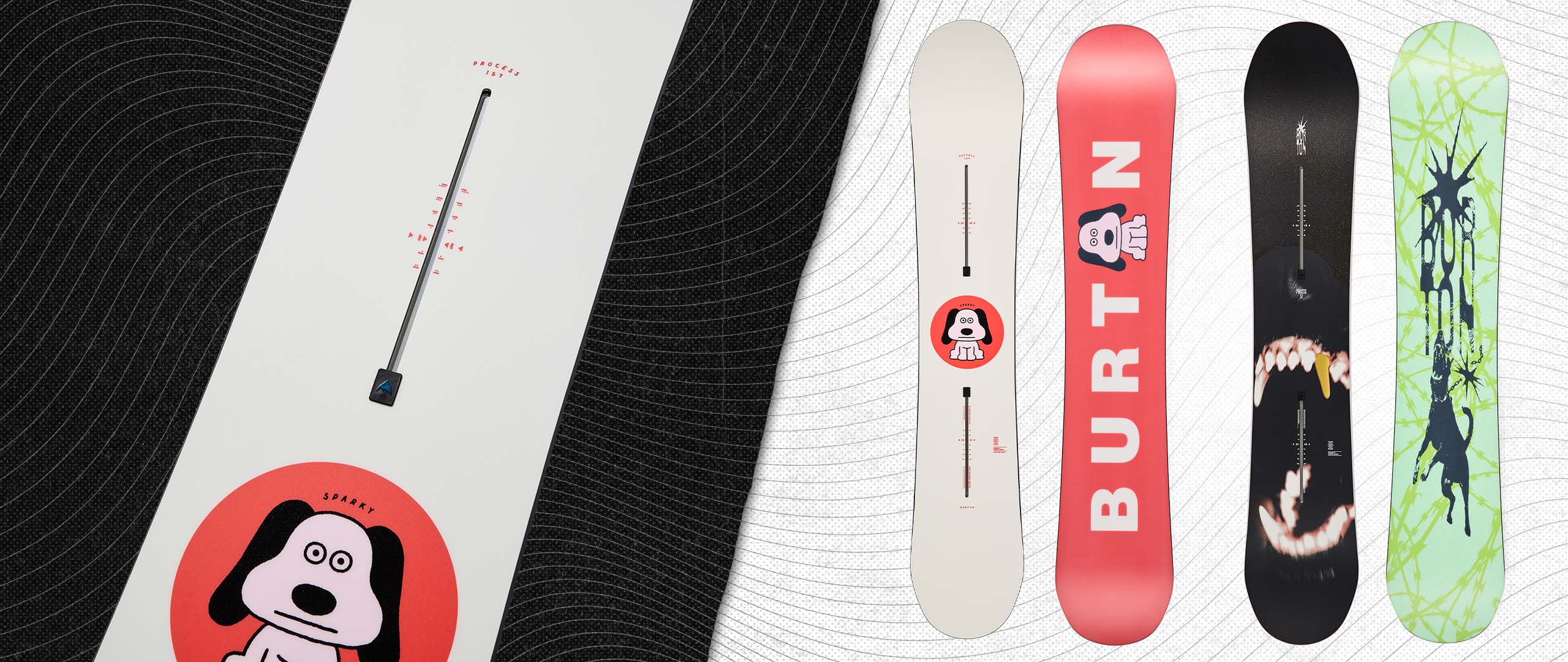
“If you’ve never tried the Burton Process, be sure to put that right this season!”
Why We Chose The Burton Process Snowboard:
Even after more than a decade, this still feels like a breath of fresh air. If you’ve never tried the Burton Process, be sure to put that right this season!
Who Is The Burton Process Snowboard For (50 words)?
A massive size range is always a dead giveaway that a board is a genuine crowd-pleaser. While definitely a freestyle board, part of its longevity is just how well its specs transfer to the entire mountain – particularly if you have a playful, ping-one-off-anything-you-find approach to resorts.
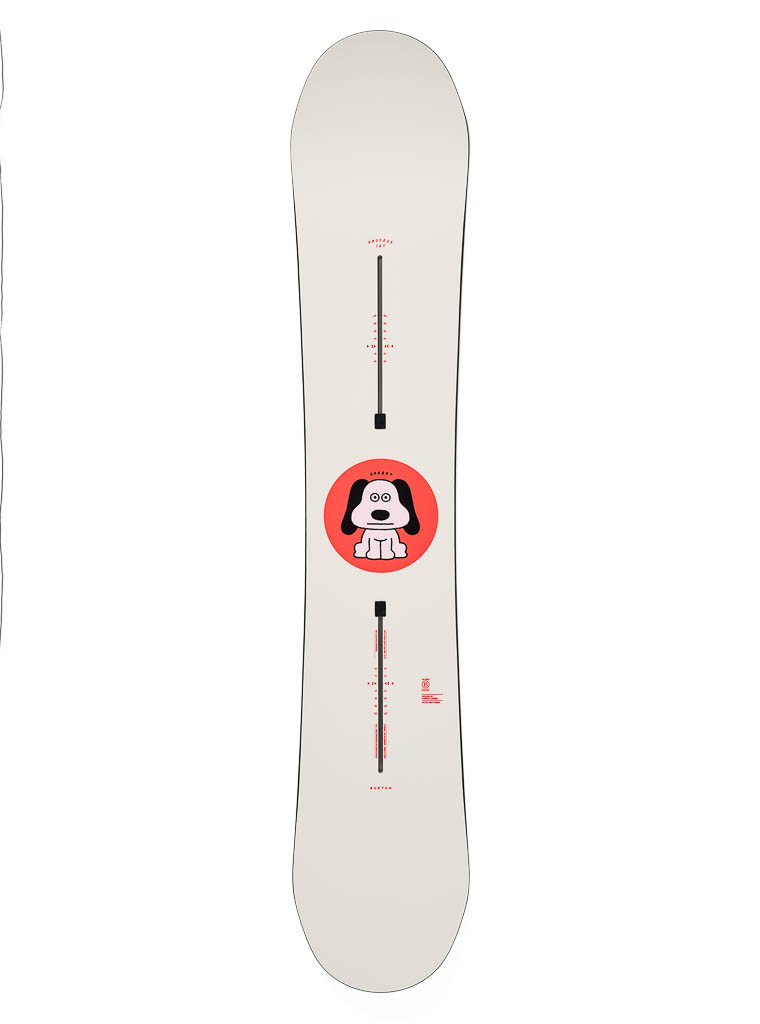
Burton Process “Good Dog” version topsheet
Shape, Profile and Sidecut:
The Burton Process is absolutely tailor-made for freestyle. Both the shape and the flex are 100% twin, which is perfect for spontaneous side-hit sessions and deepening your trick bag. Then there’s the fact that the camber is a little less pronounced than it might be,with flattish sections at each end. Not only that, it has turned-up edges at the contact points that let you get away with a bit more when sliding on a box or buttering the piste. In short, everything’s on the table. When you really want a bit of pop and power, it’s there thanks to the lively, lightweight core and mostly-camber bend. Essentially the Burton Process is that rarest of things: a precision tool when you want it to be, but not when you don’t.
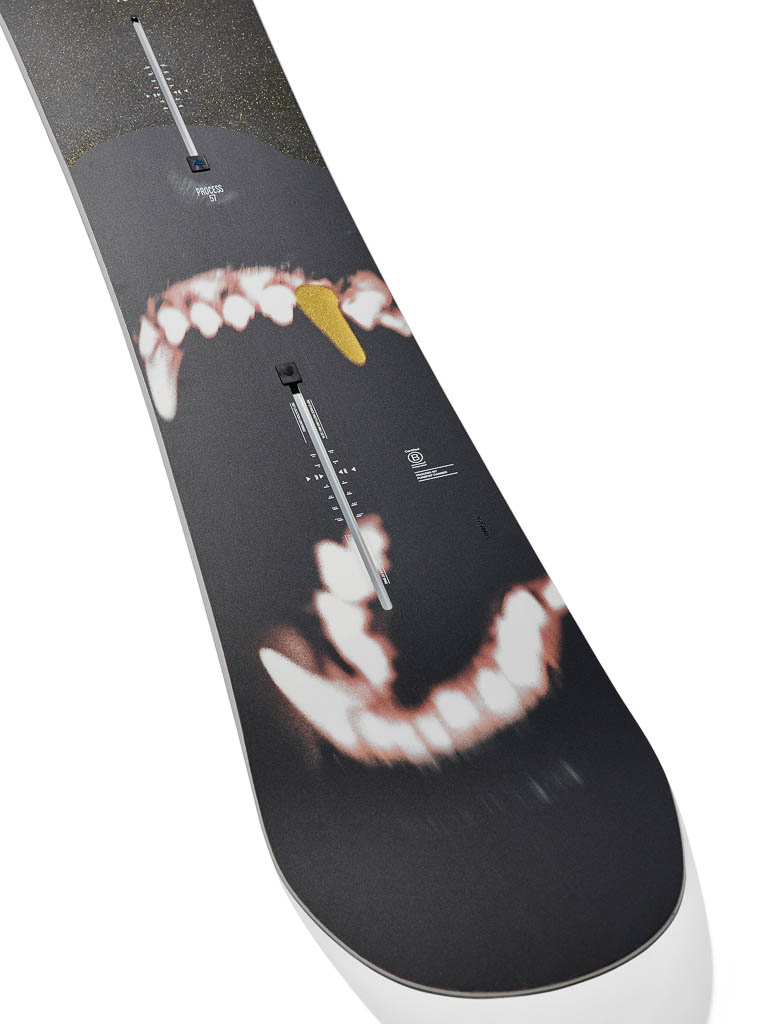
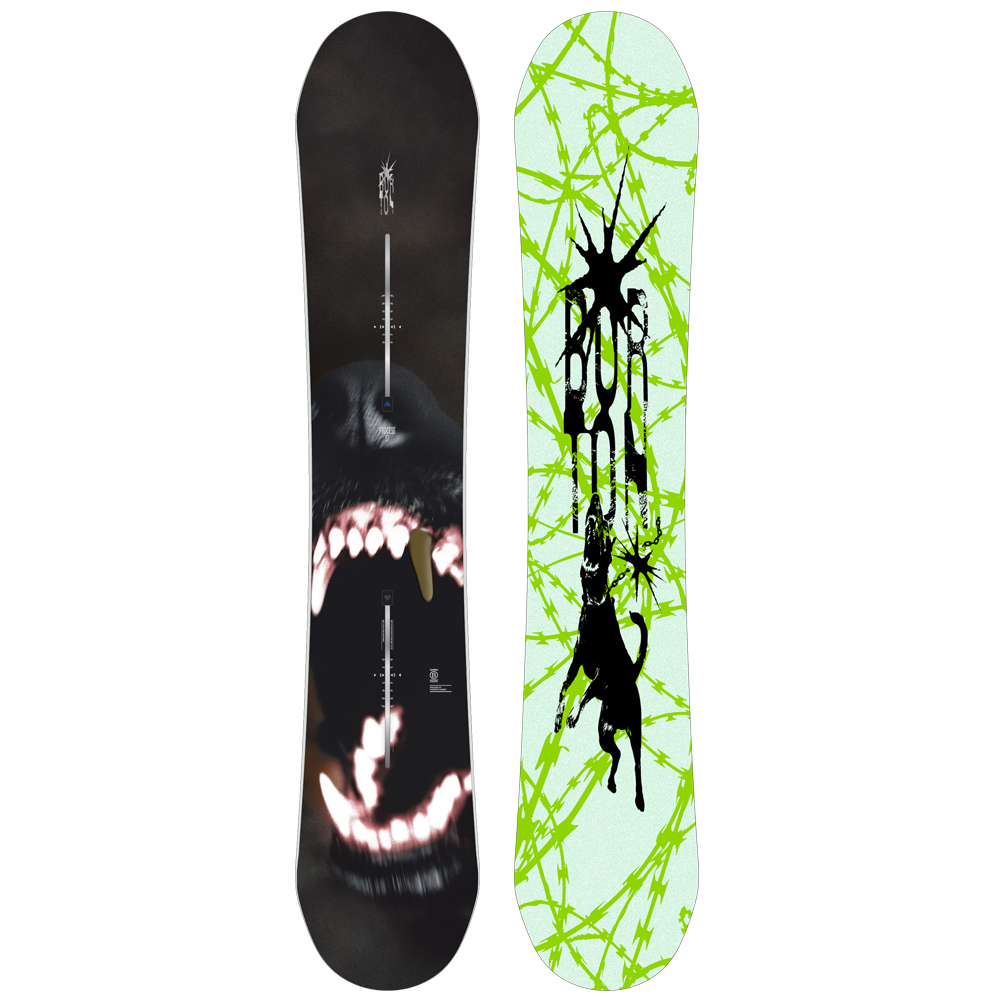
Burton Process “Bad Dog” version topsheet
Construction and Materials:
As is the case with many Burton boards, some sections of the Burton Process’ core are thinner than others. It’s done in a targeted way, starting with the nose and tail which have been shaved down to reduce the board’s swing weight. Under the feet it’s a more standard thickness making it strong enough to handle big impacts. Elsewhere there are additional thinner sections that give the Process a fairly forgiving flex from end to end – but it’s far from a jib noodle. Layers of triax fibreglass make it more rigid from edge to edge, so manipulating it with your feet takes a bit of extra work. Tame it to unlock extra confidence going into bigger features in the park, plus of course the pipe. You’ll get a bit of extra help with that from the overbuilt edges, which protrude out from under your heels and toes to dig into particularly firm or icy terrain. As with all Burton boards, the Process is held together by Super Sap, an environmentally-friendly resin that doesn’t fall short.
Watch our review of the Burton Process:
Roundup:
Going down the spec sheet of the Burton Process, it’s striking how little has changed since it first appeared. Makes sense, though; if you’ve cooked up a high-end freestyle machine that you don’t have to be Mark McMorris to appreciate, then it’s best to get that recipe locked down.
While it won’t be for absolutely everyone – if you like your board to be super stiff along both axes, for example – but it’s really not far off. Our tester took it to the powder (not the natural habitat of a true twin) and it still came up trumps. From peak to park, you can trust the Process.
Tester Verdict
Pat Nichols
“This is an absolutely perfect twin! It has a 12mm set back reference stance if you want it to be more directional on a powder day, but otherwise you can centre it to the side cut. It’s snappy, supporting, has great grip and is still pressable. It wants to go fast and have fun, and it encourages you to be playful at the same time.”
Best All‑Mountain Snowboards 2026‑27: One Board to Rule Them All
Hunting for the best all‑mountain snowboard? Our expert crew at Whitelines sorted through the hype to deliver...
We use cookies on our website to give you the most relevant experience by remembering your preferences and repeat visits. By clicking “Accept All”, you consent to the use of ALL the cookies. However, you may visit "Cookie Settings" to provide a controlled consent.
This website uses cookies to improve your experience while you navigate through the website. Out of these, the cookies that are categorized as necessary are stored on your browser as they are essential for the working of basic functionalities of the website. We also use third-party cookies that help us analyze and understand how you use this website. These cookies will be stored in your browser only with your consent. You also have the option to opt-out of these cookies. But opting out of some of these cookies may affect your browsing experience.
Necessary cookies are absolutely essential for the website to function properly. These cookies ensure basic functionalities and security features of the website, anonymously.
Cookie
Duration
Description
cookielawinfo-checkbox-analytics
11 months
This cookie is set by GDPR Cookie Consent plugin. The cookie is used to store the user consent for the cookies in the category "Analytics".
cookielawinfo-checkbox-functional
11 months
The cookie is set by GDPR cookie consent to record the user consent for the cookies in the category "Functional".
cookielawinfo-checkbox-necessary
11 months
This cookie is set by GDPR Cookie Consent plugin. The cookies is used to store the user consent for the cookies in the category "Necessary".
cookielawinfo-checkbox-others
11 months
This cookie is set by GDPR Cookie Consent plugin. The cookie is used to store the user consent for the cookies in the category "Other.
cookielawinfo-checkbox-performance
11 months
This cookie is set by GDPR Cookie Consent plugin. The cookie is used to store the user consent for the cookies in the category "Performance".
viewed_cookie_policy
11 months
The cookie is set by the GDPR Cookie Consent plugin and is used to store whether or not user has consented to the use of cookies. It does not store any personal data.
Functional cookies help to perform certain functionalities like sharing the content of the website on social media platforms, collect feedbacks, and other third-party features.
Performance cookies are used to understand and analyze the key performance indexes of the website which helps in delivering a better user experience for the visitors.
Analytical cookies are used to understand how visitors interact with the website. These cookies help provide information on metrics the number of visitors, bounce rate, traffic source, etc.
Advertisement cookies are used to provide visitors with relevant ads and marketing campaigns. These cookies track visitors across websites and collect information to provide customized ads.