The Verdict | The Olympic Snowboard Judges on the Women’s Slopestyle Controversy (and More) in their Own Words
Whitelines spoke to three of the officials charged with judging the most high-profile contest in snowboarding.
Opinions, as the old saying goes, are like arseholes: everybody’s got one, and they often stink. Over the course of this Winter Olympics, and the six freestyle snowboard events that involved judging, plenty of people saw fit to share their opinions about the judges and their decision-making. But no event kicked up as big a stink as the women’s slopestyle last Wednesday. Whether or not he was the first, the most prominent early sharer was Todd Richards, the influential ex-pro turned NBC commentator, who emerged from his booth to tell the internet “that was the worst judging I’ve ever seen at an event, ever”. He went on to accuse the officials not only of “shit judging” but also, “setting snowboarding back” in the process.
Of course, everyone knows the algorithm loves a strongly-worded statement in an easily-digestible, 9:16 video format. But it seemed like there was enough substance to Todd’s central allegation—that Mari Fukada’s run, which featured two 720s, and rails that were “not that good,” shouldn’t have beaten some of the others—for it to gain traction.
“Perhaps because of its high profile, judging the Olympics is paid far less than World Cups or other contests on the circuit”
Certainly, other people were quick to agree, both in the comments and in their own posts. Pitchforks were sharpened, torches were lit, and metaphorical buckets of tar were soon being dumped on the hapless officials from a great height, before being seasoned with a sprinkling of feathers as conspiracy theorists waded in to blame the result on the usual suspects: the FIS, and the IOC. Everybody was enjoying the digital pile-on so much that nobody (with the notable exception ofSlush Magazine) thought to question the judges themselves about what they were thinking, or why they might have awarded those scores. So, in the interests of bringing some nuance back into the debate—and just getting the basic facts straight—we decided to ask them. Whitelines spoke to Gaz Vogan and Adam “Beggsy” Begg over a WhatsApp call, while they were sitting next to each other on a snow-delayed train from Livigno to Milan, where they were catching their flights home. Beggsy, who’s Australian, is a hugely experienced judge who was chosen to lead the panel for the Milano Cortina Games. Gaz, a fellow veteran of previous Olympics, is British. He was one of several people we interviewed (alongside Todd Richards) in the aftermath of the Beijing Games, for our post-mortem article about the judging error—caused by a TV feed mistake—that led to Max Parrot being awarded slopestyle gold. As they explain below, both Beggsy and Gaz have spent much of the intervening four years, working hard to ensure that the same thing could never happen again. They pushed for the hiring of an entirely separate camera crew, to ensure they can see angles on tricks that the regular TV feed might not show, and conducted multiple, extensive workshops with riders and coaches in the run up to the Games. In the interests of better communication, they also launched a podcast, On the Knuckle, to give extra insight into their work. And as the Games kicked off, Beggsy set up a WhatsApp group with 47 commentators and snowboard pundits for all the major international TV networks—a WhatsApp group to which Whitelines was added, alongside Tim and Ed from the BBC, and Todd Richards. The hope was this would help stop misunderstandings—willful, or otherwise.
All of this has been off their own bat, and none of it (it goes without saying) was motivated by financial gain. As we reported in the aftermath of Beijing, Olympic snowboard judging is a pretty thankless task—something people do for love, not money. Over the course of the Milano Cortina Games, by our estimates, Gaz, Beggsy, and their colleagues would have scrutinised over 600 competition runs—as well as attending hours of practice, to get an idea of the level ahead of time. But perhaps because of its high profile, judging the Olympics is paid far less than World Cups or other contests on the circuit. They got free accommodation, food, and a day rate of 125 Swiss francs (£119.50). But if they wanted to snowboard in Livigno themselves, they had to buy their own liftpass. After wrapping up our call with Beggsy and Gaz (who eventually missed his flight because their train was delayed), we spoke to Iztok Sumatic, the Slovenian judge, who’s worked on every Winter Games since Sochi 2014, and took most of the heat after Beijing, as head judge. He was tired, having driven through the night with a friend after the end of the final contest. But eager to explain what had happened. We talked about the same topics, so where relevant, we’ve included Iztok’s responses to the questions below. As standard, our conversations have been edited for clarity, flow, and length.
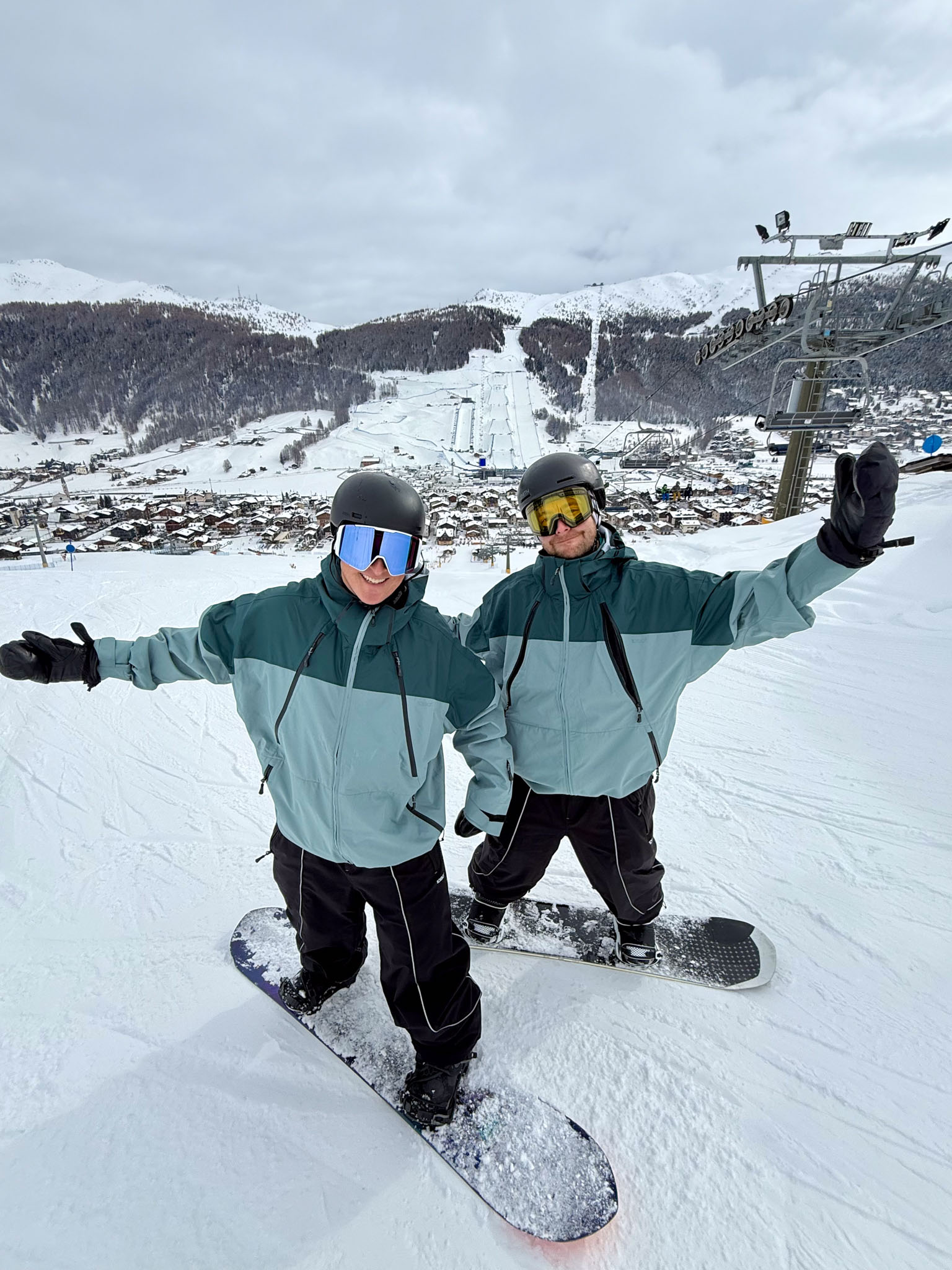
Beggsy and Gaz – Olympic judges (photo courtesy of Gaz)
Whitelines: For readers who might not know, can you just run us through how snowboard judging at the Olympics works?
Gaz: Events like big air and pipe are judged on overall impression, based on the five DAVE-P criteria: Difficulty, Amplitude, Variety, Execution and Progression. So there are six scoring judges, who each award a score out of 100 for each run, and then Beggs, as the head judge. The head judge compiles the scores, knocks off the highest and lowest to eliminate outliers, and averages out the remaining four to arrive at the final score. With slopestyle it’s a bit different. You have six section judges [one for each feature on the course], and then three composition judges [who look at the whole run, and whose scores are averaged out] and a partridge in a pear tree—or Beggsy, again, as head judge. Each section is judged out of 10 points. The composition judges give scores out of 100, but a little tabulation system compresses it down to a score out of 40, so that the total score which gets sent to broadcasters is out of 100.
“After the incident in Beijing four years ago, we realised we couldn’t really trust the OBS [Olympic Broadcast Service] to give us the consistent camera angles that we wanted.”
Gaz Vogen
And the head judge doesn’t score, right?
Beggsy: No. But I’ll discuss sort of where the score is sitting. When I get all the section scores in it’ll be discussed and I’ll say, “okay, that’s our current second place. It’s got first place on this section, this section, and this section, but a bad rail, is everyone happy with their scores?” And someone might pipe up and say “oh there was a hand touch on jump one, or an early off [a rail]”. So we communicate the facts around the run, and based off those facts, the composition judges chuck in their scores.
You used to talk about three ‘overall impression judges’ in slopestyle, instead of ‘composition judges’. Is that change of language significant?
Iztok: The main thing it means is that trick difficulty is more under the section judges. Difficulty is still there in the composition judges scores as a criteria, but the most important is the execution and the variety in terms of the tricks, and of the direction of spin, and off-axis, and grabs and all of that. So difficulty is not as integrated in the composition score as it was before.
OK, that’s obviously changed since Beijing. What other changes have you made to make sure that runs with missed grabs don’t win a gold medal?
Gaz: After the incident in Beijing four years ago (Max Parrot’s knee grab), we realised we couldn’t really trust the OBS [Olympic Broadcast Service] to give us the consistent camera angles that we wanted. For us as judges, the best way is to see the same angle for every single runner, because the perspective of the camera will change our perception of the trick. OBS [who operate all the cameras at the games, and give the same feed to all broadcasters around the world] were difficult to work with—they had loads of cameras, but wouldn’t give us full access or any kind of control over the angle, we brought in our own production team from a company called Alibaba. And they effectively managed our camera angles for big air, pipe and slope.
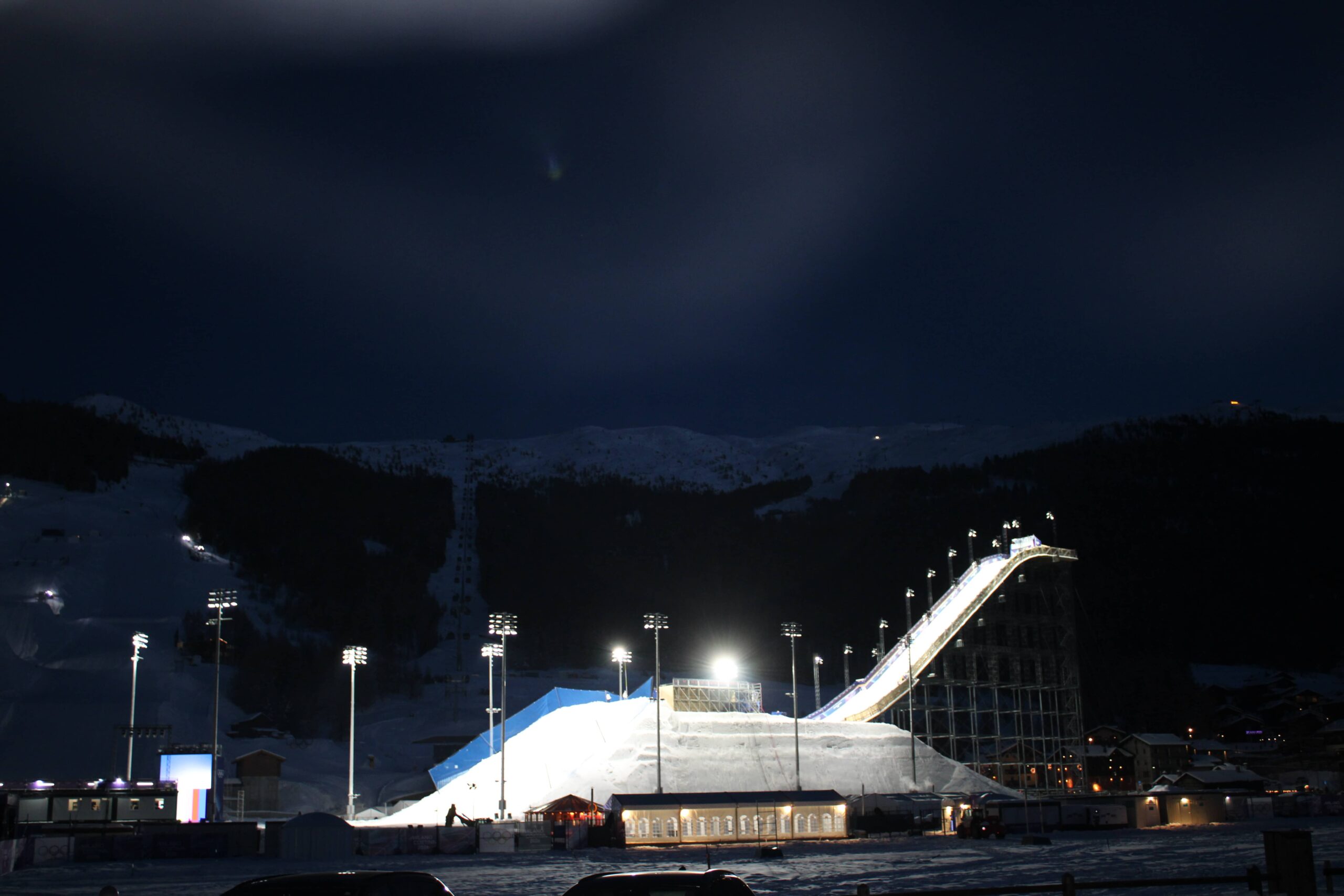
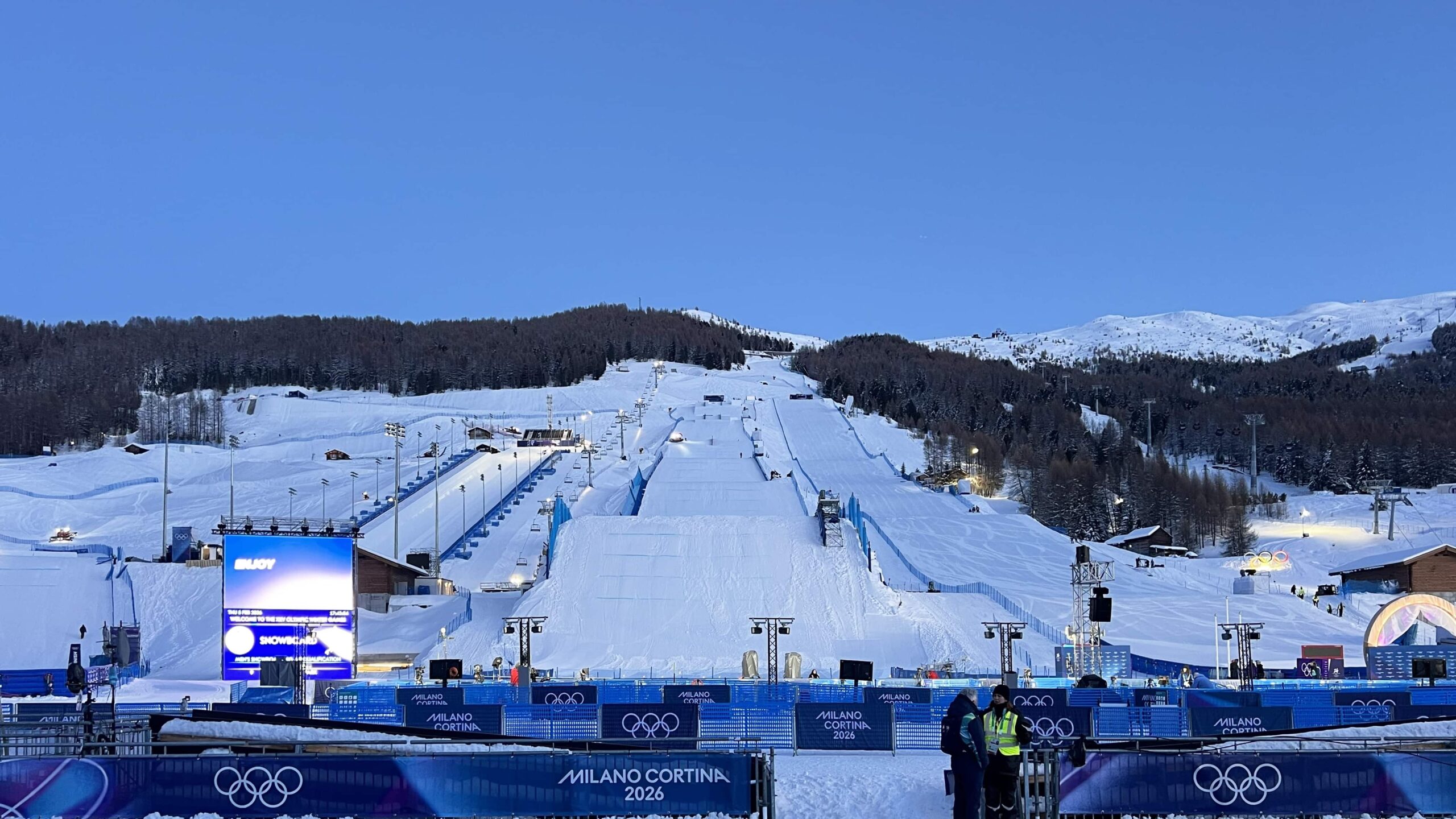
The Olympic Big Air Jump. Photo: Wikimedia
So you had your own feed, that was clearer than what we saw?
Gaz: Well I’ve heard terrible things about how the big air looked from the OBS angle, whereas we didn’t have a single missed trick from the camera the entire Games.
“And we made it clear to riders that all four directions needed to be included down the course, because it was essentially a seven feature course”
Adam Begg
You saw everything clearly then. So why did Mari Fukada’s run score more highly than Zoi’s Sadowski-Synott’s, which got silver, or Kokomo Murase’s, which won bronze?
Gaz: I guess if we start with Koko, the big sticking point from a composition perspective was the lack of a switch backside spin. That hurts her score when it comes to meeting the ‘variety’ criteria. Zoi and Mari had all four directions. Beggsy: And we made it clear to riders that all four directions needed to be included down the course, because it was essentially a seven feature course
And that was communicated in the rider meetings before?
Gaz: Yes, both in the Team Captain’s Meeting [where coaches and rider representatives meet with event officials before a contest], and directly to coaches and riders on a WhatsApp group.
I guess that explains why Koko’s trick score was higher than Zoi’s [49.80, compared to 48.95] but her composition score [36.0 compared to 38.53] was lower?
Gaz: Yeh, that’s what composition kind of takes into account, it’s the variety—so all four directions of spin—the execution, and the progression, to an extent. Beggsy: Also with Koko’s best-scoring run, her first rail was a bad score. It was an easy rail, easy trick, but poorly-executed.
“The key point with Mari’s run was it was absolutely flawless execution.”
Gaz Vogen
Looking at the score sheet breakdowns, it says one of Koko’s rails was switch backside boardslide. That doesn’t count as a switch backside rotation?
Beggsy: If you think about the actual rotation, it’s a switch back board, so she’s still facing forward. It’s basically a cab boardslide, so it’s not a switch backside rotation.
OK yes, I get you. And what about Todd Richards’ point, which was (to paraphrase a bit) “how can a run with two 720s win in this day and age?”
Gaz: The key point with Mari’s run was it was absolutely flawless execution. She was locked over the rails, had all the grabs—the execution was completely flawless. If you look at Zoi as the key comparison, because she was in second, it was that second section with the frontside lipslide that she slipped out on. So yes Zoi had a very nice jump line of 900, 1080, 1080, but one of the sections already was down at a 4.6. Taking that execution into account was kind of key.
Beggsy: Mari’s was the only flawless run on the day. Every other run had little instabilities, whether it’s an early-off, or a hand touch, or an edge of some sort. This one was flawless from top to bottom.
Gaz: Mari also had all the four directions, and then also the front seven at the end was off the toes. So that gives her a little boost in terms of the composition and variety scores because she’s got different take-offs. Not a gigantic boost, but it’s definitely taken into consideration.
Ah yes, you said in your WhatsApp chat with commentators (and me) that “take-offs will be a focus for the season, and will be used as a separator if needed”. Where does stuff like that get agreed on?
Gaz: With these criteria, we spent quite a lot of time with the community the last two or three seasons doing riders’ meetings, and getting their perspective. So the idea of different take-offs being scored higher comes from the riders themselves.
They think it’s harder to take-off like that, so it merits a higher score?
Gaz: Yes exactly. But the grand scheme of what came back from those meetings was that even with progressive tricks, riders still want them to be well-executed, with long held grabs and so on. It’s a nice way of us not turning into [ski] aerials.
Right, the execution score has always been the closest thing to “style points,” basically. It’s kind of ironic that many of the same people who are complaining about two, flawlessly-executed 720s winning a women’s slopestyle contest have been saying for years they want to see slower, stylish spins in contests, rather than spin to win…
Gaz: Well, yeah.
“…if suddenly a switch back rodeo 12 scores well, then more people start trying them.”
Gaz Vogen
Switching to big air, I noticed in the men’s final, Frank Jobin was getting high scores for his double rodeo and switch backside double rodeo, even though they were ‘only’ a 1440 and a 1260, and everyone else was spinning 1800s and 1980s. That’s also to do with it being a different take off?
Gaz: Yes and a different axis of rotation. That’s been a common theme at least the past two seasons of World Cup big air contests. And again, it comes from the riders. If the riders want to go spin to win, then awesome, we’ll judge like that. But when the riders are telling us that rodeos or weirder, low-rotational tricks on different axes—like Eli Bouchard’s tricks—are harder and deserve more points, then we’re happy to reward those. And we’re happy to work with the community to figure out where, for example, Eli Bouchard’s trick sits next to the range of more traditional spins.
Andrei Antipov via ShutterStock
Right. There were more of those—from Eli and others—in big air qualifiers than in the final. And I actually kind of agreed with Todd Richards, when he accidentally had that hot mic moment, and said the final was boring compared to qualifying because of that.
Beggsy: I mean, if you look at qualifications, we had a number of switch rodeos, butter tricks, pullbacks, all that sort of parallel direction of the sport, and they were awarded [high points]. They all got really good scores, amongst the 18s. But most of the riders doing those tricks didn’t get a backup trick. Unfortunately Frank was the only one to get through the finals. So definitely the messaging [to the riders] was there in qualifications. But the people that got through to finals ended up going down the spin to win road.
You talk about messaging, like the scores encourage riders to push in that direction?
Gaz: Things like that always do indirectly end up influencing the sport, because if suddenly a switch back rodeo 12 scores well, then more people start trying them. Beggsy: But that all comes from the chats we’ve had to riders in Big Air about slowing down the space race of extra 180s. It’s this creative, unique, different axis spin, alley oops in halfpipe, all these other things that they’re pushing. Iztok: It’s like the spark that was lit by giving the gold medal in Sochi to Sage [Kotsenburg] with his Holy Crail grab. Other people started concentrating more on different grabs. I guess that’s sort of what we’re doing here, and the same in halfpipe.
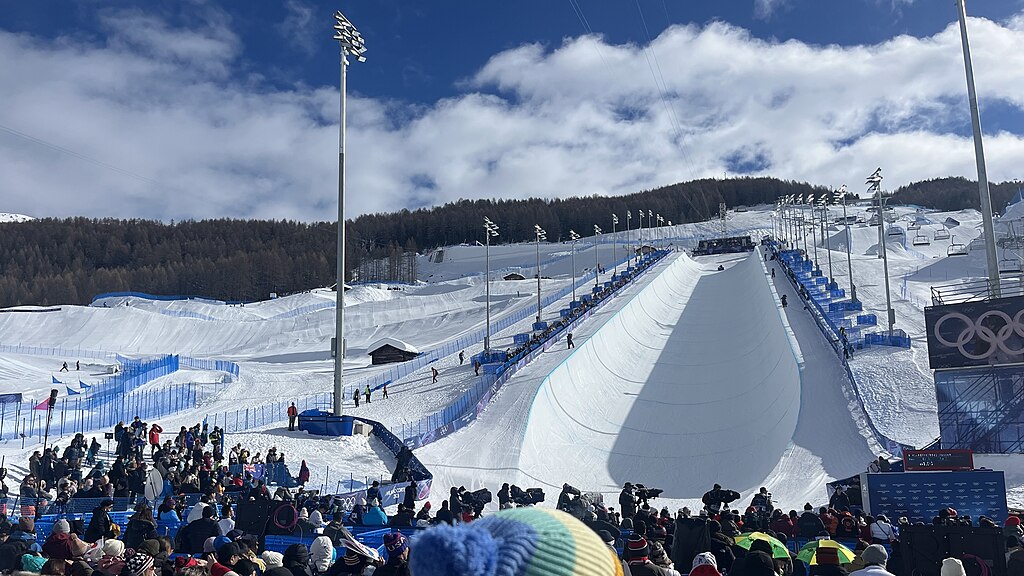
2026 Olympic Halfpipe. Photo: Wikimedia
I wanted to talk about halfpipe. Scotty James [who finished second] looked visibly unhappy with his score, compared to Yuto Totsuka’s gold medal run. What happened there?
Gaz: The execution was probably the biggest point, because on Scotty’s first hit and his last hit he came in a little bit under-rotated, so didn’t have the clearest landings. Scotty had really good combinations, like from the back 10 to switch back 14, and then from the switch back 14 to the back 16 that he wanted to do on that last run [when he fell]. But on the second run it was execution. Yuto was more flawless and had—I almost call it four and a half directions, because it’s the four primary directions plus the alley oop.
Would Scotty have won if he’d landed that final 16?
Gaz: Well, you’re getting into hypotheticals. But it’s an NBD [never been done] combo. Maybe not a complete NBD actually? But definitely an RBD—rarely been done.
Iztok: You can say Scotty was very close.
“Ryusei’s run just blew my mind.”
Iztok Sumatic
Interesting you mentioned the alley oop. Ryusei Yamada had this crazy alley oop off the heels, that presumably pushed his score higher?
Beggsy: Yeah, it was a switch frontside alley-oop 10 off the heels, which is another NBD in competition. Off the heels, back up the pipe.
Yeah, a total headfuck to watch
Beggsy: Yeah, that’s one of those really unique tricks that he’s the only person in the world doing it.
Iztok: Ryusei’s run just blew my mind. No disrespect to the stellar amplitude of Valentino Guseli. No disrespect to Ayumu’s run, Jake Pate’s run, like I could name them all, but all I’m saying is that alley oop was so on point. And when it comes to progression, so this is me specifically talking as a scoring judge at this particular event, the alley oops is that one frontier to still be explored and where you can still push the progression in a big way.
Gaz: With that progression criteria we look at whether it’s a new rotation, or whether it’s just elements of a trick that push the sport forward [like a unique take-off]. Ryusei’s trick scores big partly on the difficulty—to go switch alley-oop rodeo mid-run, and then follow up with a pretty big back double 10—and partly on the progression. We look at tricks like that, the more people that start doing that trick, then the less kind of progressive reward it gets. But it would still have the difficulty reward.
Interesting, so the more unique a trick is, the higher it scores. Scotty was one of the people who pushed that in the last four to eight years, introducing his unique switch back 12 ahead of Pyeongchang I think it was?
Gaz: The irony was yeah that Scotty was probably the first one on that kind of variety of having all four directions and different takeoffs.
“Yeah but women’s big air goes down as my favourite contest I’ve judged.”
Gaz Vogen
But everyone has caught up?
Iztok: I would say the top eight athletes all overcame themselves, and that was the raddest, the most progressive, the best snowboarding in half pipe I’ve ever seen.
It felt like a pretty progressive Olympics overall. With some caveats, obviously—there were speed issues for some of the women in slopestyle, and the big air jump wasn’t massive for example.
Gaz: Yeah but women’s big air goes down as my favourite contest I’ve judged. Women’s snowboarding is just progressing at a very rapid rate nowadays, and that was on display. And then the community around women’s snowboarding is so sick. So when Kokomo lands, everyone’s like cheering her on and clapping her and stuff.
Beggsy: And the fact that Kokomo got reduced to tears when she won a medal. You don’t see her crying over an X Games medal, but yet she was sort of ecstatic when she won that one.
Gaz: And the fact that Mia went for the back 16, which I don’t think she’s ever landed?
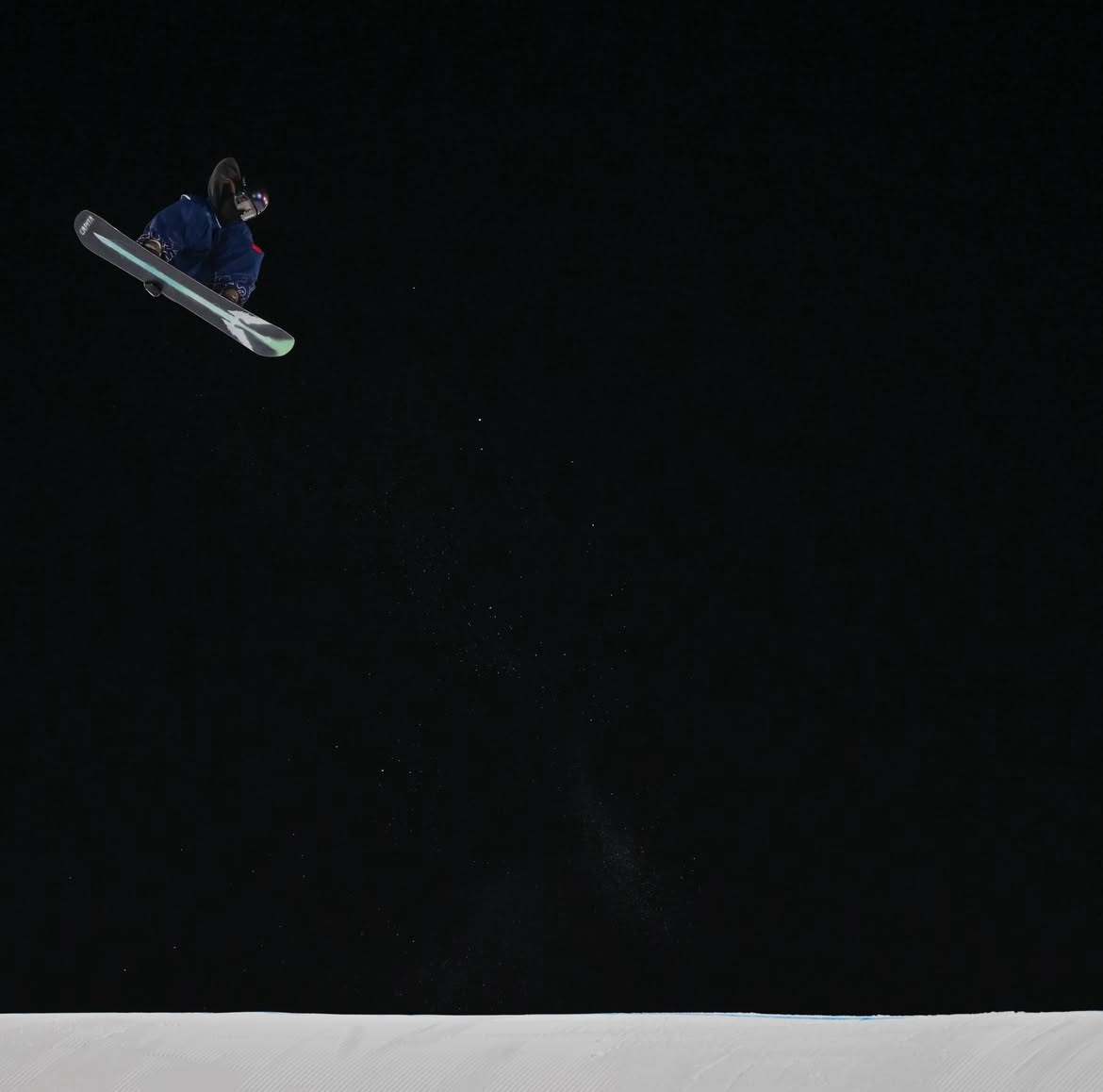
Mia sending it in Big Air. Photo: Instagram/Mia-Brookes
Apparently she’s never even tried it on snow before. As a Brit, I’ve got to ask, if she held onto that, would she have won?
Gaz: Kind of hard to say. I would have definitely given her a shot of being up there and thereabouts.
Very diplomatic haha. Anyway, thanks for talking us through it all.
Gaz: Thank you. A few hours after our interview wrapped, Gaz relayed a message from Beggsy via text: “Can you let Whitelines know that I back the team 100 percent. There is nobody I would rather have on such a big event. Their experience, knowledge, work ethic, and calmness under pressure was why they were selected for this. They judged to the criteria and the guidelines set in riders meetings. And that despite how it went down in slope they are the current best in the world!”
We use cookies on our website to give you the most relevant experience by remembering your preferences and repeat visits. By clicking “Accept All”, you consent to the use of ALL the cookies. However, you may visit "Cookie Settings" to provide a controlled consent.
This website uses cookies to improve your experience while you navigate through the website. Out of these, the cookies that are categorized as necessary are stored on your browser as they are essential for the working of basic functionalities of the website. We also use third-party cookies that help us analyze and understand how you use this website. These cookies will be stored in your browser only with your consent. You also have the option to opt-out of these cookies. But opting out of some of these cookies may affect your browsing experience.
Necessary cookies are absolutely essential for the website to function properly. These cookies ensure basic functionalities and security features of the website, anonymously.
Cookie
Duration
Description
cookielawinfo-checkbox-analytics
11 months
This cookie is set by GDPR Cookie Consent plugin. The cookie is used to store the user consent for the cookies in the category "Analytics".
cookielawinfo-checkbox-functional
11 months
The cookie is set by GDPR cookie consent to record the user consent for the cookies in the category "Functional".
cookielawinfo-checkbox-necessary
11 months
This cookie is set by GDPR Cookie Consent plugin. The cookies is used to store the user consent for the cookies in the category "Necessary".
cookielawinfo-checkbox-others
11 months
This cookie is set by GDPR Cookie Consent plugin. The cookie is used to store the user consent for the cookies in the category "Other.
cookielawinfo-checkbox-performance
11 months
This cookie is set by GDPR Cookie Consent plugin. The cookie is used to store the user consent for the cookies in the category "Performance".
viewed_cookie_policy
11 months
The cookie is set by the GDPR Cookie Consent plugin and is used to store whether or not user has consented to the use of cookies. It does not store any personal data.
Functional cookies help to perform certain functionalities like sharing the content of the website on social media platforms, collect feedbacks, and other third-party features.
Performance cookies are used to understand and analyze the key performance indexes of the website which helps in delivering a better user experience for the visitors.
Analytical cookies are used to understand how visitors interact with the website. These cookies help provide information on metrics the number of visitors, bounce rate, traffic source, etc.
Advertisement cookies are used to provide visitors with relevant ads and marketing campaigns. These cookies track visitors across websites and collect information to provide customized ads.